In this post, I combine gaps and swings to map and trade the 20-minute JPY. You will see how I use gaps and swings to isolate a Change in Behavior and to also see the direction of price. I use them again to show me the trade entry where I am willing to risk my stop.
The key thing to learn is this, how to use our tools and not be used by them.
Trade Craft
All Things Concerning the Language of Price
The Uncertainty of Gaps, The Space Between What Was and What’sTo Be
In the last post, “Mapping Markets With Gaps” I showed you how to structure a market with Gaps and finished the video by marking out a few markets live. In this video Im going to follow up those charts and see what we can learn from what happened when price interacted with those levels. These are the kinds of things we do in the Language of Markets Live sessions in order to take what we are learning into practice and application. In the video, I also go over the three types of trade options related to gaps. You can see a video on the Three Types of Trades in the “Principles of Trading” section of the home page. Gaps show us an area of supply/demand imbalance that we can take trade advantage of in many ways once we understand them.
Do It With Gaps
In the last post “Map Any Market in Any Time Frame” I showed you how to map markets using swings. There are various ways to map a market and in this video, I will show you how to do it with Gaps. Gaps are significant supply/demand events and once we learn how to isolate them on a chart, we can view the market through them eliminating the rest of the noise. This gives us an easy means to map, follow and have various ways to trade this event. See a post I did on ” Trading a Valley in the CAD” for an example. Learn to follow price and price will teach you.
Map Any Market in Any Time Frame, Part 1 of 3
This is the first of a three-part series in which I teach simple and objective ways to map and follow any market in any time frame. Whether you’re trading ticks or minutes or dailies, trading simply and objectively is equivalent to trading based on the facts, not on setups or predictions or magic numbers. This independence comes by way of seeing and isolating market structure and reading the language of price.
Isolate major and minor swings in any market or time frame.
Foundations of Trading Part 5: Trading Journals
Each trader has their own brand of crazy and we need to see it all cause we can’t improve what we don’t see. The main purpose of a trading journal is to become more conscious of ourselves, markets and of us trading markets. There are many ways to structure it but keep it as simple as possible, personal to your needs and let it evolve as you do. You mainly want to use the trading journal to have a place to be accountable and make observations of your trading. What you find will help you to create any needed disciplines or make any adjustments in what or how you trade.
In the end, we are working towards mastery of our trading craft which requires working towards mastery of ourselves. A trade journal is a tool that helps us take responsibility for everything we think, feel and do when it comes to trading. If you have some resistance to it, just do what you can and ease your way into it. The writing by itself will begin to loosen some things up. In the video, I will give some ideas about how to structure your journal.
Shane Blankenship
Foundations of Trading Part 4: Trade Planning
We make a trade plan, execute, then evaluate to see what we can learn about price and ourselves. Making and documenting a trade plan helps us to clarify what it is were doing and thinking at the time of a trade, it makes us more accountable. A trade plan can also serve the purpose of holding us steady after we are in the trade and subject to more emotional reaction.
A trade plan is a personal thing that needs to be adapted to you and your trading. Its best to keep it simple. My trade plan just asks a few simple questions and then I take a snapshot of the chart.
- Why am I entering?
- Why am I placing my stop there?
- Why am I moving my stop?
- Why am I exiting?
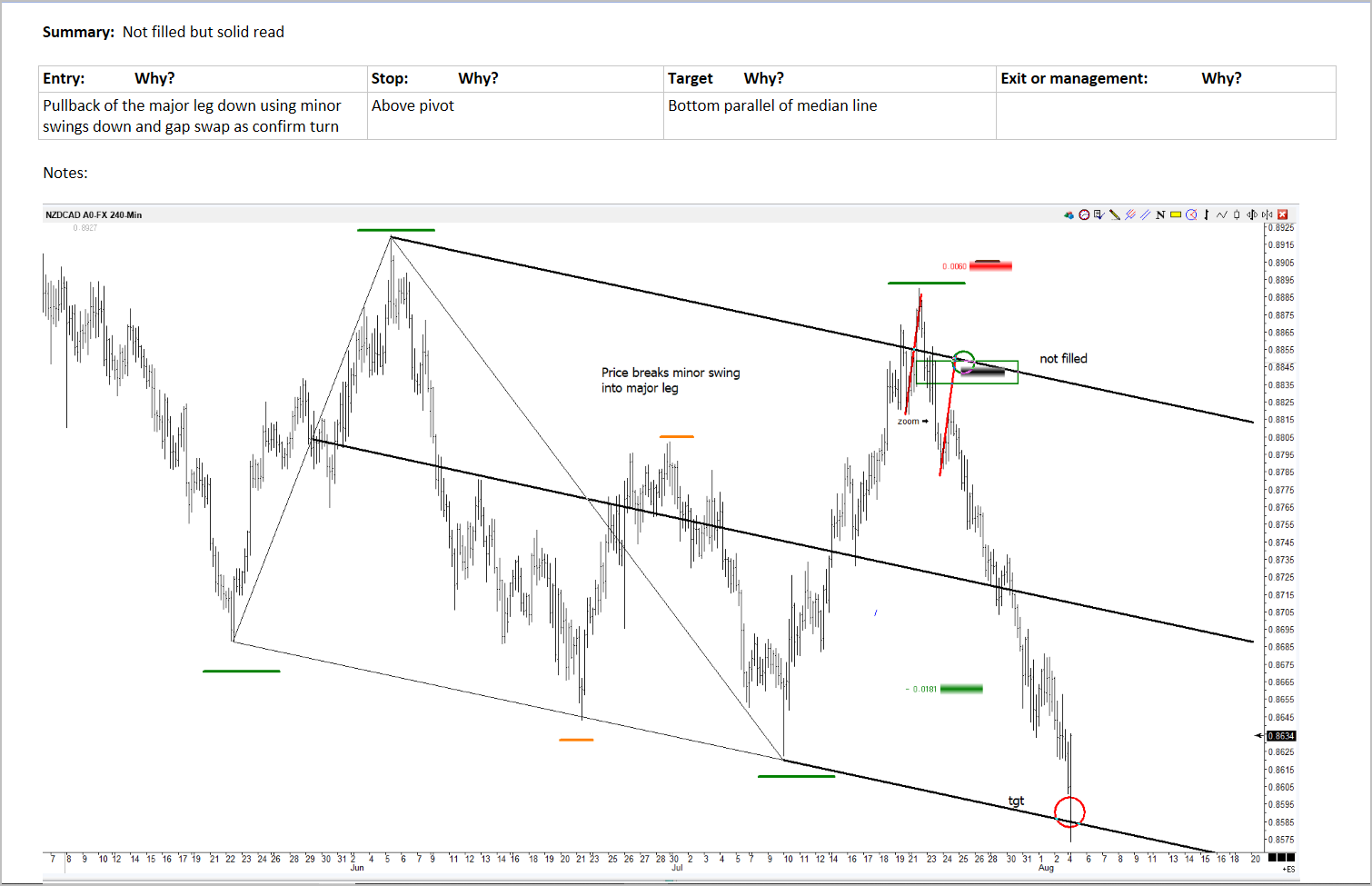
Its a simple question that asks why are you doing what you are doing? Don’t just be technical about this, also answer the questions as honestly as you can. If you entered a market cause you were impulsive or because the moon was blue or whatever.. write that down. If you are placing your stop real close cause you are scared of risk, write that down. If you jump out early cause you cant take take it anymore write that down. Don’t be embarrassed you have plenty of company including me now and then but you can be one of the few who actually takes an honest look and learns. Here is a recent trade plan of mine that did not get filled.
Shane Blankenship
Foundations of Trading Part 3: Andrews Median Line Tools
The Andrews Median Line is a simple tool that can be applied any instrument in any time frame. It beautifully describes and projects the process of a swing cycle. The Median Line simply bisects a price swing using the relationship from any 3 alternating pivots and then projects price back to its median to complete the swing cycle. If there are two extremes, (opposites) there must also be a center. I refer to Median Line tools cause there are a few basic types of Median line sets along with a some other lines tools. With a thorough understanding of these tools and swing structure we can use them very purposefully fro particular situations.
Median Line Tools
- Standard Median Line set
- Pendulum Median Line set
- Modified Schiff Median Line set
- Reverse Median Line set
- MPL – Multi-Pivot-Line
- Action Reaction Lines
- Sliding Parallel
Foundations of Trading Part 1: Preserving Your Capital
This is the first in a series of foundational lessons on the principles of trading. These foundational lessons are relevant to any instrument, time frame or methods that you use.
- Preservation of Capital
- Market Structure
- Andrews Median Line Tools
- Trade planning
- Self-Management
We start with money management. Because if you blow through your money you won’t last long as a trader. Money management starts with self-discipline, which is the first thing every trader should begin to foster. Preservation of capital is paramount. If you’re not currently profitable, cut your trading size down; you have to earn the right to size. Always use hard stops, which means, put in a stop order at the same time that you place your entry order. Know your maximum risk per trade, and stick to it. My risk management is 1.6% of my account per trade.
We will talk about Market Structure in the next part of this series.