Last month we followed the Nasdaq E-Mini futures and NZD/USD into historic volatility and crazy. We mapped and followed them calmly with simple swings the same way we always do, the only difference is that the swings were bigger. This is an important time to stabilize our practice of seeing markets calmly and objectively. I emphasize the word “follow” because there is a big difference between predicting and following. This Month we will follow the Dow E-Mini futures and EUR/USD.
Trade Craft
All Things Concerning the Language of Price
Mapping The S&P E-Mini Weekly
We all see things differently and mostly experience markets through past personal experiences which distorts what is going on. We especially get our buttons pushed during times of high volatility and uncertainty. Mapping markets simply and objectively always needs to be the starting point, to orient ourselves to “What Is” rather than what we want or don’t want. It’s not a trader’s job to predict markets, it’s our job to follow and join them no matter what they are doing. In this video, I map out the E-Mini S&P weekly chart along with a few stocks, AAPL, VRTX, AVGO, SQ, BAC, and GILD.
Adjusting Stops for Volatility
When volatility changes so must our stops and we need to keep in touch with this. Here I review how to calculate stops using a simple Average True Range method (ATR) that I mentioned in Foundations of Trading Part 6 Risk Management. I also go over the current 20-minute currencies to show how to keep in touch with this volatility.
Simply Noticing: Carnival Cruise Line
Trading doesn’t have to be overly complicated and we don’t need to predict the future. We can look outside all the news, noise and see what price is doing. In this video, I simply notice where buyers keep picking up Carnival Crusie Line (CCL) every time it comes down during a crisis.
Foundations of Trading Part 6: Risk Management
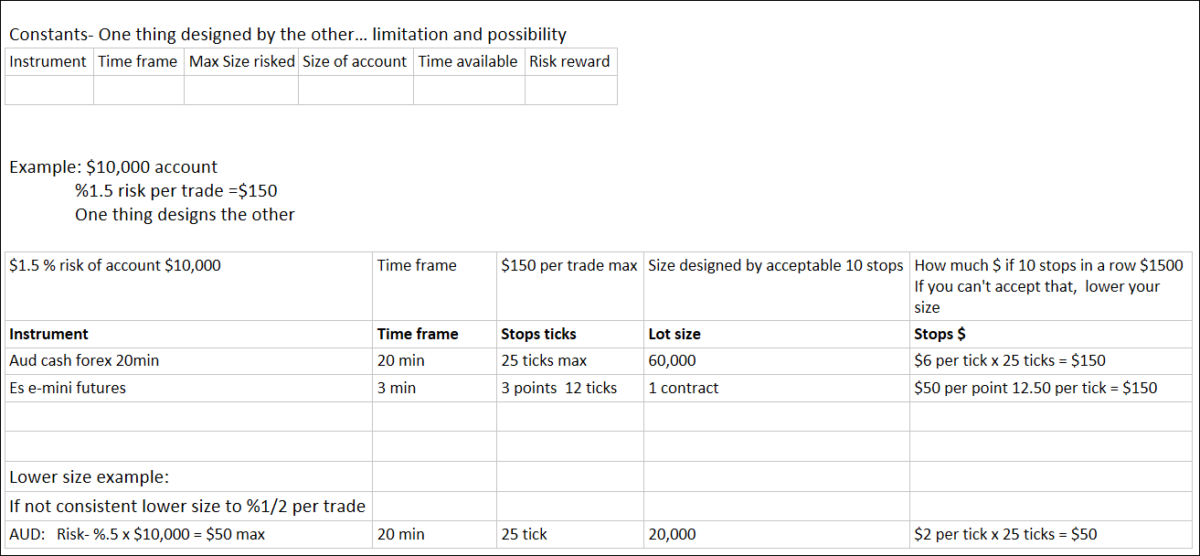
In Foundations of Trading Part 1, I stated the number one rule was the preservation of capital. We have no control over what markets do but we can take control of our money management and risk. In this video, I lay out some basic guidelines for working out maximum stop size with ATR (average true range) and designing our risk management plans. The image below shows an older example of a maximum stop size for AUD and ES. In the video, I show how to get the current maximum stops. You can use my simple guidelines for ideas in creating your own risk management plan and then ingrain it to the point where it’s not a discipline but a normal part of trading life.
Learning To Be Wrong
Effective trading is not about trying to be right on each trade, it’s about being fluid in an everchanging market. When we approach each trade trying not to be wrong, there is a layer of fear that clouds how we see things and effects our every decision.
This video is a Clip From one of our Live Sessions where I talk about consciously practicing with being wrong while demonstrating on a live USD/JPY market. I give a practice exercise to loosen up this aversion. As traders, we are going to be wrong a lot so its best to dispell the shame of it so we can approach each trade with more clarity.
The Beauty Of Median Lines
Let us understand the principles of what Median Lines are and what they do, then we can own them and use them to trade in our own ways. Our goal in learning about Andrews Median Lines is to understand what Allan Andrews understood, not to mimic him or anybody else.
In the Mapping Any Market any time Frame series, I show how to map markets with swings. In this video, I show how Median Line sets describe and project these swings and how to read the market one swing at a time.
Following Live: Theory Into Practice, February 2020
Change is the nature of markets, so the most important ability to develop as traders is how to change with change, to practice fluidity and not get stuck so much. The EUR/USD we followed last month was a lesson in practicing being able to flow with change by following relative swings from up to down. The E-Mini S&P taught us how price can push balanced minor swings up. This month we will map and follow Soybean futures and the USD/JPY.
A Study of How Price Moves
It’s not enough to just know how to recognize a market structure or memorize a bunch of technical analysis. That’s a start, but then we want to use those things to learn about how price moves and get that feel into our bones. In this video, I look at last week’s USD/JPY and E-Mini S&P mapping these markets using major/minor swings and the frame of the 3 types of trade options to learn about how price moves.